In-house legal is often seen as the default owner of every contract across the business. But in reality, that responsibility takes valuable time away from the legal work they were hired to do. Contract ownership belongs with the business, and thanks to AI, making that shift is easier than ever. Here's why.
1. Challenges in a modern work environment
If you ask what the biggest challenges for in-house legal are, you will probably hear
-
A wide range of knowledge domains (contract law, HR, IP, GDPR,...)
-
Knowledge of different jurisdictions when the company operates in multiple countries
-
Workload that is too high
-
Reconcile commercial interests with limiting the legal risks
And as much as these are real challenges, as a legal counsel you are trained for this. You have the knowledge, or at least you know where to acquire that knowledge or how to find a solution. What does feel like a big challenge are those things you are not trained for or have no control over. And challenges that you have no control over create frustration and tension.
For a legal counsel, the question "How do I keep control over the contractual processes?" is considered to be one of those challenges. On the one hand, these processes are often spread throughout the organization, making it difficult to keep an overview of all contracts. On the other hand, the responsibility for everything contract-related soon becomes the legal counsel’s burden. In this manifesto, you’ll learn why this is not a sustainable situation and how it can be remedied.
2. What are contractual processes and responsibilities?
When you look at vacancies for in-house legal, you will soon notice that 'contract management' is often part of the job description. But what exactly is contract management? In a company, the following procedures are considered 'contractual processes’:
-
Retention of relevant documents
-
Risk management
Together, these processes form, with each of the stages in the contract lifecycle containing specific challenges for the in-house lawyer.
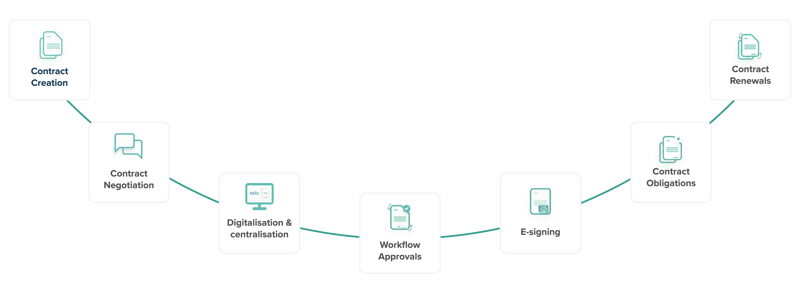

Contract Creation
-
How do I avoid reinventing the wheel whenever drafting a contract?
-
How do I make sure everyone uses the right templates?
Negotiation
-
As a legal professional, how can I be involved in the negotiation in time so that I do not lag behind the facts?
-
How do I make sure that the business knows exactly within which limits they can negotiate, so that, as a legal professional, I only have to be involved in exceptions?
-
How do I make sure everyone knows who has to approve which kind of contracts?
-
How do I safeguard the process, so it cannot be circumvented, and it is also clearly traceable afterwards?
-
How do I make sure contracts get approved efficiently and on time?
-
How do I make sure everyone knows who should sign which type of contracts?
-
How do I make sure contracts are signed efficiently and on time?
-
How do I always get the countersigned document?
-
How do I make sure the person who has to sign doesn't have to wonder who approved the contract?
-
How do I give people access to the contracts relevant to them, and only to those contracts?
-
How do I ensure that I can easily find information, no matter from which angle I ask the questions? (e.g. contracts of a certain counterparty, certain type of contracts, for a specific department or business unit, ...)
-
How do I make sure all relevant documents, including relevant e-mails, can be found centrally, together with the contract?
-
How do I keep an overview of all versions of a contract and immediately find the latest version?
Follow-up of contractual moments and agreements
-
How do I make sure that what we have negotiated is actually being implemented and followed up?
-
How do I ensure that the responsibility for a contract rests with the person who knows what the contract’s content is about and not with me as a legal counsel?
-
How do I make sure follow-up tasks automatically end up with the right person without me having to act as a contract mailman?
-
How do I keep an overview of what needs to be followed up for all contracts throughout the organization?
In 80% of European organizations, these challenges are commonplace for in-house legal. In essence, they can be summarized in two thorny points:
-
Collaboration between the legal team and other teams is hindered in the absence of a streamlined contracting process with clearly defined responsibilities.
-
Keeping an overview and control over contracts is impossible because they are spread throughout the organization and are kept up to date in different places (online & offline).
What is needed here is a decentralisation of responsibilities across contracts that can be monitored from one central place, so legal
should not be held responsible for the follow-up of contracts!
3. Why the legal counsel is not responsible for contracts
This is a frequently heard complaint from corporate lawyers, while the legal department spends a harrowing amount of time dealing with purely administrative questions about contracts, such as "Where's that contract?" When is the cancellation deadline? What was agreed again?
The lion's share of these questions are things the person who asks you could either find himself, or automatically get notified of (cancellation dates, milestones, agreements, ...). In general, this administrative work can quickly consume a full FTE. The reason these questions are fired at the legal counsel is because you are often seen as the contract responsible or contract owner. Unjustly, of course, because as a legal expert, you want to use your time and expertise to:
-
Draft contracts (or templates)
-
To review and negotiate contract proposals
-
Limit the risks for the company, proactively where necessary
-
Resolve contractual issues that arise during a contract’s lifecycle.
That's what you're trained for, and that's where you bring value, in line with the cost you mean to the company. The follow-up of the contract and the responsibility for its implementation must rest with the business. And that is why in-house legal should not be responsible for the contracts
However, as a legal counsel, you can be responsible for the contracting process. You can ensure that there is a clear procedure and the right tools are available to make sure all contractual processes are under control, preferably in an efficient manner and adapted to the needs of the business. Let’s dive deeper into how you can set up this kind of process in the next chapter.
4. The legal counsel of the future
On the internet and at networking events, (AI-powered) legaltech is all the talk when it comes to the future of the legal profession. At the same time, the overwhelming supply of diverse software makes it impossible for corporate lawyers to see the wood for the trees. That is why we provide a few quick wins on how you can optimize the contracting process in your organisation, step by step. Even without extensive knowledge of software implementations or large budgets.
1. Stay away from Excel and document management software (e.g. Google Drive, Dropbox, OneDrive, ...) to manage your contracts
This software is (partly) free and makes it tempting to get started right away. However, the big problem with DMS is that they are not adapted to the specific needs of your contracts. You also want to see all information bundled in one place, and that’s not something a DMS is built for.
You keep track of the cancellation dates in Excel, your contract parties are in a CRM and the contracts are spread across different folders per department, making it impossible to work efficiently.
At the end of the day, the money or time you save with a DMS is quickly cancelled out because the margin of error is too large with this way of working. Cancellation dates are overlooked, finding contract information takes too long and important documents are lost, leading to great losses in time and money and perfectly avoidable frustration.
2. Make it clear to management that the value of a legal expert is in the legal and not in the administrative
If you get caught up in having to manage contracts yourself or being the go-to person for contract administration, then you will not get enough time to do those things where you bring value yourself: the essence of the job as a legal counsel. Try to make it clear within your organization from the start that the responsibility for a contract lies with the business. If someone is also responsible for either ISO, , compliance, ... then you will certainly find an ally with them to support this message. Or share this paper with your team to give them insight into the challenges & responsibilities of your role within the company.
If you have been working in the same organization for some time, you can use this as a reason to identify and (re)define contract responsibilities internally. Be aware that especially your team will understand the return on investment of contract management and would very much like to have a solid contract management system. In many cases, even 1 contract that doesn't go wrong will probably pay back all of your investment. Because what does it cost if you don't have control over your contracts? Calculate the ROI of a good follow-up of your contracts with this handy ROI calculator.
3. Let yourself be assisted by specialists
Don't try to reinvent the wheel, and let yourself be assisted by people or solutions that go beyond the mere delivery of technology. For example, there is such a thing as contract management as a service: companies to which you can outsource the administrative part of contract management, so you can focus on the high-value contracts. For the choice of the appropriate technology, you can also consult experienced legal tech consultants who know perfectly:
-
How to start the search for new software and how to advise you,
-
How you approach the change process within your organization when implementing new software
-
How they can translate the needs of your organization into a streamlined and optimized process.
4. Automate administrative tasks with Artificial Intelligence (AI)
Today, AI can speed up or take over a lot of time-consuming work, and this goes beyond just text analysis. So be sure to look for software solutions that use artificial intelligence or at least have a credible roadmap for it. You can map out for yourself which steps you can automate or simplify with artificial intelligence. Below you can find some examples:
-
Creation: draw up contracts faster using AI-generated templates or based on AI suggestions for the most relevant clauses.
-
Negotiation: during the negotiation phase, artificial intelligence can help the contract originator to evaluate contracts more quickly. Your contract software identifies the most important information and risks, making negotiations easier, faster and more secure.
-
Validation & signing: smart approval workflows make contract approval and signing processes run more smoothly while strictly following the required order of signatures and reviews.
-
Succession: with the help of AI, ensuring that you do not overlook any data. This way, you always have a handy summary of your contracts and documents that can be read in a jiffy.
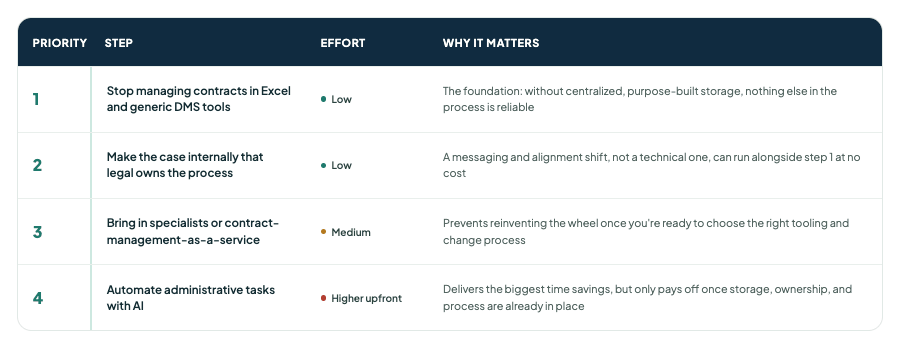
5. Four practical steps toward a future-proof contracting process
Shifting this responsibility doesn't require a legaltech overhaul overnight. It starts with a few deliberate moves. Making this shift doesn't require a legaltech overhaul overnight, a big budget, or months of implementation. It starts with a few deliberate, manageable moves and the impact builds from there.
Step 1: Move away from spreadsheets and generic document management tools
Excel trackers, Google Drive folders, and shared drives feel like a quick fix, but they aren't built for the specific needs of contract management. Deadlines get buried in one place, counterparties live in another, and documents are scattered across departments. The time "saved" upfront is lost many times over when a renewal date slips through the cracks.
Step 2: Make the case internally: legal expertise, not legal administration
If you're the default contact for every contract question, you won't have time for the work that actually requires legal judgment. Make it explicit: to management, to your CFO or to compliance, that contract ownership sits with the business. A software implementation project is often the perfect moment to redefine these responsibilities.
Step 3: Don't do it alone
Contract management as a service and experienced legal tech consultants exist precisely to take the administrative weight off legal's shoulders, while helping translate your organization's needs into a process that actually works, without requiring a big budget or a long-term implementation.
Step 4: Let AI take over what it does best
This is where the shift becomes sustainable. AI can support nearly every stage of the contract lifecycle:
1. Creation: AI-generated templates and clause suggestions speed up drafting.
2. Negotiation: AI surfaces key risks and information so contracts can be evaluated faster.
3. Approval & signing: Smart workflows keep the required order of reviews and signatures intact, automatically.
4. Follow-up: AI extracts key dates, obligations, and data from every contract, so nothing gets overlooked.
Take the first step toward the future!
Curious how Contractify can prepare your legal team for the future?
Book a demo ⬇️