Contract management goes beyond storing signed documents. It's about knowing what you owe, what's owed to you and when either of those changes. World Commerce & Contracting puts the average cost of getting this wrong at 9% of annual revenue. The best-performing companies hold that number to 3%. The sloppiest lose 15% or more... Do the math for yourself.
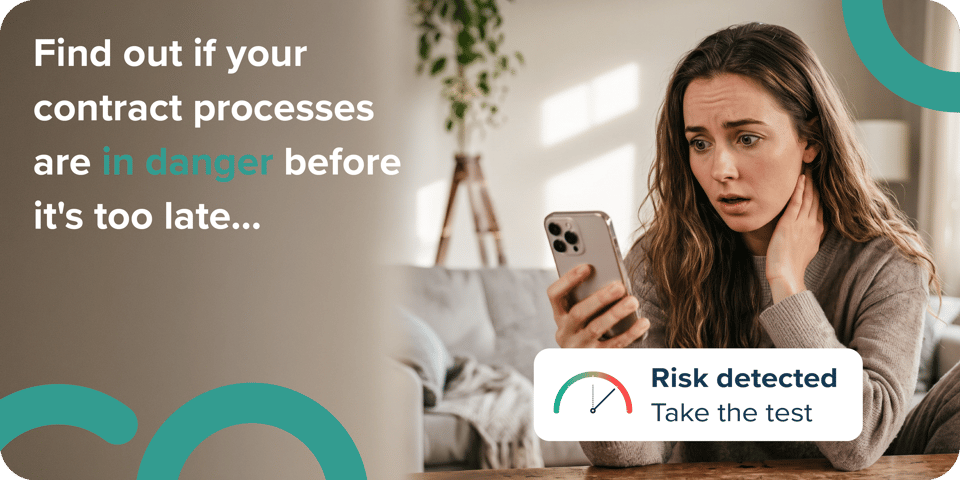
In this blog post, we give you the 7 most common risks and how to avoid them.
Want to know if your contracts are at risk? Take the test below 👇🏼
Risk 1: Scattered contract data
On average, contract data lives across 24 different systems: shared drives, email inboxes, ERP tools, spreadsheets... Finance has access to the purchase agreements. Legal knows which clauses are in the contract. Procurement sees the vendor terms. Nobody sees the full picture.
That's not just inconvenient, it's the reason unnoticed auto-renewals slip by, compliance checks turn into a manual search and renewal negotiations start without the contract history to back them up. Lack of overview and ownership might be the biggest and most common risk of all.
Risk 2: Unwanted automatic renewal
Around 85% of all B2B contracts include an auto-renewal clause with a notice period of 30 to 90 days. If you miss that window, you're locked into another term, at a price you never agreed to revisit.
Say your team grows and you need a bigger office. But you forget to cancel the lease on your old one in time. Now you're stuck paying for space you don't need, for another full term.
The fix isn't avoiding auto-renewal clauses, it's centralising renewal dates and notice periods so someone can actually act before the deadline, not after.
Risk 3: Obligations that continue after the contract ends
A contract's end date doesn't close the file. Confidentiality clauses, data deletion duties, transfer obligations, and residual warranties often run well past termination, and teams stop tracking them the moment the contract feels "done".
The result: confidentiality breaches nobody catches, GDPR fines for data that should've been deleted months ago, and warranty windows that quietly close while you're not looking. Once a contract disappears from your radar, so does every obligation still running inside it.
Risk 4: Compliance
The compliance risk involves GDPR fines, which can run up to €20 million or 4% of global turnover, or NIS2 fines run up to €10 million or 2% of turnover for essential entities, with possible personal liability for management. NIS2 also requires security obligations to be written into vendor contracts, not just checked once at onboarding.
Keep the clauses an auditor will ask for (security requirements, data processing terms, breach notification duties) tagged and retrievable per vendor, not buried in a PDF no one has reopened since signing.
Risk 5: No (quick) overview
71% of companies can't locate 10% or more of their contracts when someone actually goes looking for them. Legal checks one drive while procurement checks another and finance keeps its own spreadsheet. Nobody checks the same one.
Every question about a contract turns into a scavenger hunt when there's no shared view: who owns this vendor relationship, what did we agree to last time, does this clause still apply, ... That search repeats every time the same question comes up and the time adds up faster than most teams track.
Risk 6: A weak position at the negotiating table
Renegotiating a vendor contract takes 7 to 10 weeks on average. If everything runs smoothly and there are no major issues, companies close it in about 5 weeks. When a lot of questions arise, or timing isn't on your side, it can take close to 16 weeks or more.
The difference isn't luck, it's preparation. Walking into a renegotiation without a clear view of current spend, comparable contracts and what you already won last time puts you in a weaker position than you need to be. You're negotiating from memory while the vendor negotiates from data.
That gap shows up in the outcome: worse pricing, terms that don't reflect your actual usage and concessions you didn't need to make. Teams that track this information before the conversation starts negotiate from a position of leverage instead of catching up.
Risk 7: Knowledge loss when people leave
The person who leaves is often the only one who knew that a vendor had an informal pricing arrangement, or that a clause was never actually enforced in practice. That knowledge isn't written down anywhere, so it leaves with them.
It surfaces at the worst moment: a new hire enforces a clause the old one always waived, or misses a discount nobody thought to document. The vendor remembers the informal deal. Your team doesn't. That mismatch alone can cost more than the departure itself.
The opportunity: contract knowledge that lives in a system survives staff turnover. Contract knowledge that lives in someone's head doesn't. Once the exceptions, side agreements and unwritten norms sit on the contract record instead of in one person's memory, a departure becomes a handoff instead of a loss.
Are you aware that your contracts are at risk?
All of these risks can be addressed by ensuring visibility that is not based on who has signed the contract or who still remembers it. There is no need for you to try to work out where your company falls in relation to these 6 risks. The Contract Risk Analyser will take you through each of them and provide you with a score together with a recommended next step within about two minutes.
Take the test with our Contract Risk Analyser ⚠️