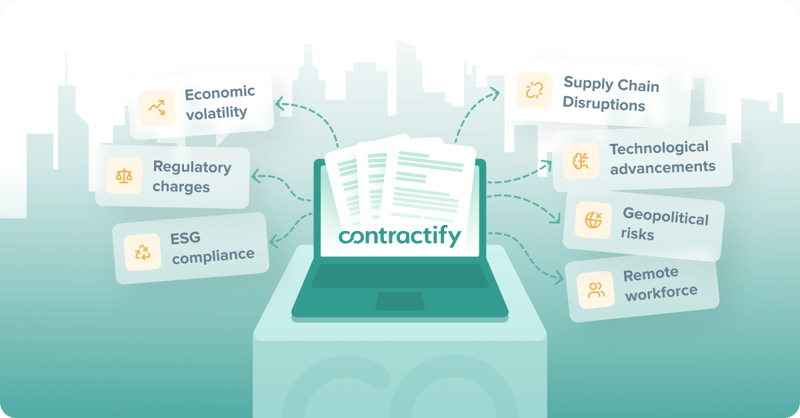
Uncertainty has become a permanent feature of today’s business landscape. Market volatility, regulatory pressure and organisational change are no longer temporary disruptions. According to recent research by WorldCC (World Commerce & Contracting), most organisations now accept uncertainty as the new normal. Yet contract management is still treated as an administrative function. And that gap is becoming a serious business risk.
In short:
- Uncertainty is no longer temporary. It is the new business reality.
- Weak contract management foundations become a serious risk in uncertain times.
- Scattered contracts lead to missed renewals, unclear obligations, and hidden exposure.
- Contract visibility enables faster, better-informed decisions when pressure is high.
- Treating contract management as a strategic capability builds adaptability and resilience.
- With structured contract lifecycle management, contracts shift from an admin burden to a business advantage.
Uncertainty exposes weak contract management foundations
When contracts are scattered across inboxes, shared drives, or disconnected tools:
-
organisations lose their ability to respond quickly,
-
renewal deadlines are missed,
-
obligations are unclear,
-
and risks stay hidden until they turn into problems..
For in-house legal, procurement, and finance teams across Europe, this lack of visibility creates daily friction. Contracts sit at the heart of supplier relationships, revenue, and compliance, but without a structured lifecycle, they slow organisations down rather than supporting growth.

Contract management as a resilience capability
Strong contract management enables two things organisations urgently need: adaptability and resilience.
Adaptability means being able to adjust agreements, suppliers and commercial terms when circumstances change. Resilience means maintaining control and continuity when pressure increases. Both depend on one thing: knowing what is in your contracts and being able to act on that information.
This is where contract lifecycle management makes a real difference. A centralised, accessible contract repository with clear ownership allows teams to make faster, better-informed decisions.
Contract visibility enables faster business decisions
In uncertain environments, speed matters. When leadership teams need to adjust suppliers, renegotiate commercial terms or assess exposure, they rely on accurate contract information. Without a central overview of active agreements, teams lose valuable time searching for documents, validating versions or manually reviewing clauses.
A structured contract management approach provides immediate access to key data points such as termination rights, pricing mechanisms, indexation clauses and renewal timelines. This allows legal and procurement teams to support strategic decisions rather than react under pressure.
Resilience is built before disruption happens
Organisations often discover weaknesses in their contract management when it is already too late. Disputes escalate, suppliers fail to deliver or budgets are exceeded without clear contractual recourse.
Resilient organisations take a different approach. They continuously monitor their contracts, track obligations and review risk exposure across their portfolio. Contract management becomes a proactive discipline rather than a reactive one, reducing surprises when external conditions shift.
From operational burden to strategic enabler
Contract management has traditionally been associated with administration. But as uncertainty increases, its strategic value becomes clear. Contracts define how organisations collaborate, allocate risk and create value.
By investing in contract lifecycle management, organisations create a shared source of truth that supports legal certainty, financial control, and operational flexibility.
 Moving beyond risk prevention
Many organisations respond to uncertainty by adding controls. More approvals. More rigid templates. More process layers. While this may reduce certain risks, it also increases complexity and slows execution.
Modern contract management takes a different approach. Instead of focusing solely on prevention, it enables confidence. Clear ownership, transparent data and structured follow-up allow teams to act decisively without losing control.
Why this matters for European organisations
European companies operate in complex regulatory and cross-border environments. Managing contracts manually or reactively makes it harder to stay compliant and competitive at the same time.
Treating contract management as a strategic capability is no longer optional. It is becoming a prerequisite for operating effectively in uncertain conditions.
Want to see how much visibility you really have across your contracts?
👉 Get our free contract checklist for a full overview of all your company’s contracts