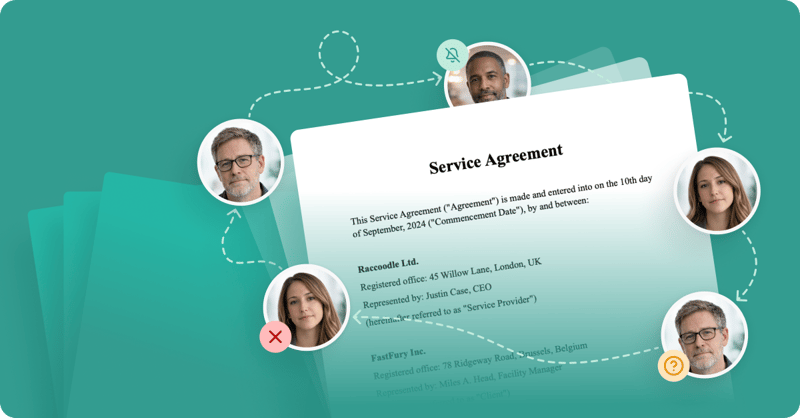
One of the biggest risks in contract management often goes unnoticed on a risk register: unclear ownership.
In many organisations, contracts are everyone’s responsibility and therefore no one’s responsibility. Legal drafts them. Procurement negotiates them. The business executes them. And accountability disappears somewhere in between.
In short:
- Unclear contract ownership is one of the biggest hidden risks in contract management
- Fragmented processes create blind spots, from negotiation through post-signature follow-up.
- The result: missed renewals, unmanaged obligations, and duplicated workload across teams.
- Clear governance enables faster collaboration and reduces operational and financial risk.
- Contract management technology only scales when accountability and roles are well defined
Shared responsibility creates blind spots
Fragmented ownership leads to fragmented processes, for example:
-
Contracts are negotiated without a clear handover
-
Post-signature follow-up is inconsistent
-
Reporting is incomplete or unreliable
When uncertainty increases, these blind spots quickly become operational and financial risks. Missed renewals, unmanaged obligations and supplier disputes are often symptoms of governance gaps rather than bad intentions. According to GrowCFO, companies lose on average 9% of annual revenue due to poor contract management. You can easily do the math for your own company.
Fragmentation increases workload instead of reducing risk
When ownership is unclear, contract-related work multiplies. Teams duplicate reviews, chase information across departments and rely on informal knowledge held by individuals. This increases operational workload without improving outcomes.
In practice, fragmented processes often lead to late involvement of legal or procurement, rushed approvals and inconsistent contract terms. Over time, this creates technical debt within the contract portfolio, making it harder to standardise or automate later.
Clear ownership supports cross-functional collaboration
Clear contract governance does not mean removing flexibility from the business. On the contrary, it creates a framework within which teams can collaborate more effectively.
When ownership is defined, stakeholders know when to involve legal, who is responsible for follow-up and how decisions are escalated. This reduces friction between departments and allows contract management to support business velocity rather than slow it down.
Resilience is built before disruption happens
Organisations often discover weaknesses in their contract management when it is already too late. Disputes escalate, suppliers fail to deliver or budgets are exceeded without clear contractual recourse.
Resilient organisations take a different approach. They continuously monitor their contracts, track obligations and review risk exposure across their portfolio. Contract management becomes a proactive discipline rather than a reactive one, reducing surprises when external conditions shift.
Governance as a foundation for scalability
As organisations grow, informal contract processes no longer scale. What works for a small number of contracts quickly breaks down when portfolios expand across regions, entities or business units.
Establishing governance early allows organisations to scale contract management without increasing headcount proportionally. Technology plays a key role here, but only when supported by clear roles and responsibilities.
Contract governance is not bureaucracy
Contract governance is often misunderstood as centralisation or control. In reality, it is about clarity. Who owns the contract lifecycle? Who is accountable for performance? Who ensures obligations are followed up on?
Research shows that organisations with clear contract ownership perform significantly better under pressure. Clarity enables speed, not bureaucracy.
Technology without ownership does not scale
Many teams invest in contract management tools to reduce workload. But without defined ownership and processes, technology adoption remains shallow. Data quality suffers and reporting is questioned.
Contract management software works best when it supports a clear operating model. Central storage, role-based access and automated reminders only deliver value when responsibilities are defined.
A practical starting point
Improving contract governance does not require a major reorganisation. It starts with one decision: assigning accountability for the contract lifecycle.
From there, technology becomes an enabler instead of a patch. Centralising contracts and automating follow-up creates transparency across departments and reduces dependency on individuals.
Struggling with fragmented contract ownership and overview?
👉 Contractify makes it easy to assign the right person to the right task in a well-organized CLM process.
See it for yourself during a 7-day free trial 👀